
Vinyl soffit is the cheapest and lowest-maintenance option but tolerates extreme cold the worst; aluminum handles temperature swings best but costs more and can dent; wood is the most repairable and paintable but needs the most upkeep. Choose vinyl for budget and low maintenance, aluminum for climate extremes, and wood if you want to match an existing painted trim scheme.
Key takeaways
- Vinyl soffit is governed by a real industry standard, ASTM D4477, and is typically the least expensive material.
- Wood needs priming and painting on all sides and periodic repainting; vinyl and aluminum need little more than an occasional hose-rinse.
- Vinyl can become brittle in extreme cold and expands/contracts more with temperature than aluminum.
- Specific “X years of lifespan” numbers you’ll see quoted online mostly trace to contractor marketing, not a standard or manufacturer spec — we checked an actual manufacturer warranty instead of repeating those figures.
- Use the scored comparison table below to match a material to your climate, budget, and how much DIY repair work you’re willing to take on.
How do vinyl, wood, and aluminum soffit actually compare?
Each material trades off differently across four things that matter for a homeowner: how well it holds up to your climate, how much upkeep it needs, how easy it is to repair yourself, and what it costs. None of the three is the “best” material outright — the right pick depends on which of those four you weight most.
What does the scored comparison look like?
Scores below are qualitative (low/medium/high) rather than a single numeric index, since no source publishes a validated scoring system for this comparison — this is an original synthesis built from the standards and sources cited throughout this article.
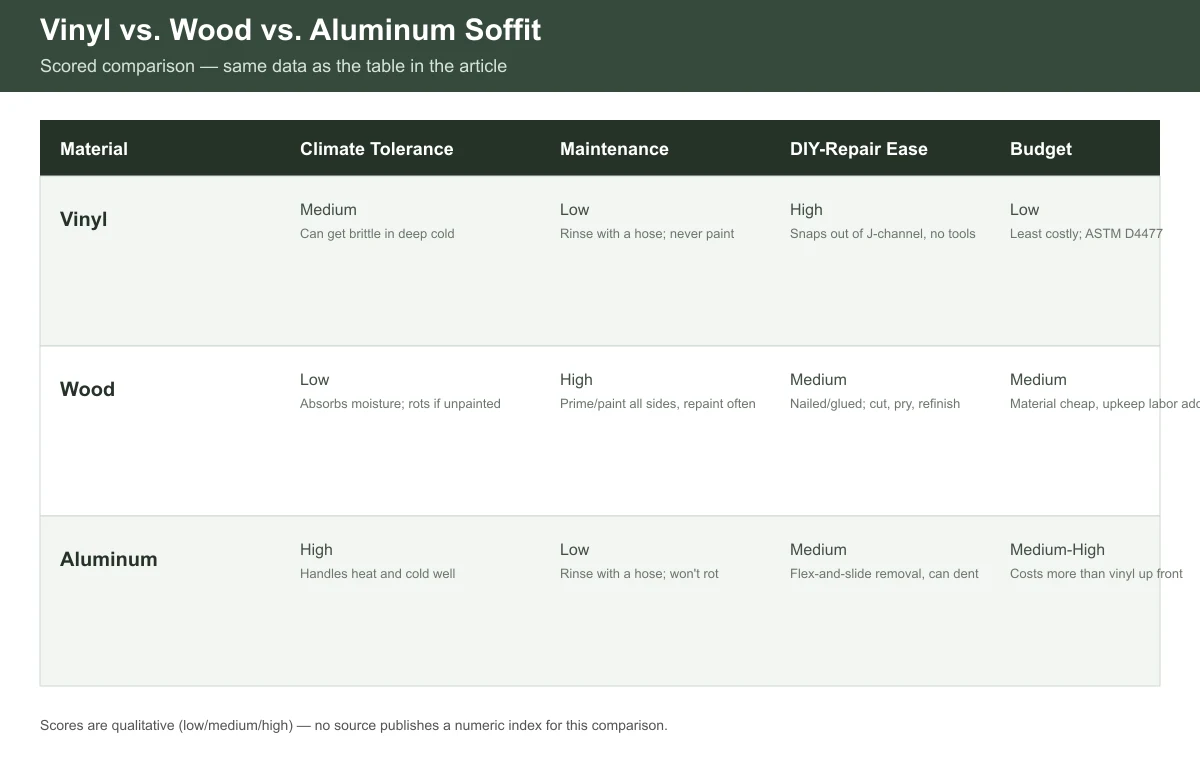
| Material | Climate tolerance | Maintenance | DIY-repair ease | Budget |
|---|---|---|---|---|
| Vinyl | Medium — can become brittle in deep cold; expands/contracts more with temperature than aluminum | Low — rinse with a hose; never needs paint | High — snaps out of the J-channel with a zip tool, no cutting tools needed | Low — typically the least costly of the three, and governed by ASTM D4477 |
| Wood | Low — absorbs moisture and rots if any side is left unpainted | High — prime and paint all sides, repaint on a regular cycle | Medium — nailed and/or glued; needs cutting, prying, and refinishing tools | Medium — cheap material cost, but repeated repainting labor adds up over time |
| Aluminum | High — handles both heat and cold well, more dimensionally stable than vinyl | Low — rinse with a hose; won’t rot | Medium — flexes out of the J-channel, but panels can dent if mishandled | Medium-high — costs more than vinyl up front |
Is there an actual standard for vinyl soffit?
Yes. Vinyl soffit sold in the U.S. is commonly manufactured to meet ASTM D4477, the Standard Specification for Rigid (Unplasticized) Poly(Vinyl Chloride) (PVC) Soffit. This standard sets requirements and test methods for the material, dimensions, camber, impact strength, thermal expansion, and appearance of extruded vinyl soffit panels — it’s a different standard from ASTM D3679, which covers vinyl siding, not soffit. D4477 also specifies that soffit meeting it should be installed per ASTM D4756, a companion installation practice, on top of the manufacturer’s own instructions. If you’re comparing vinyl soffit products, checking that a product references D4477 is a concrete way to confirm it meets an actual industry specification rather than just a manufacturer’s own marketing claim.
How long does each material actually last?
This is the question most contractor blogs answer with a specific number of years, but those numbers trace back to marketing content, not a standards body or a manufacturer’s own published spec — so treat any precise lifespan figure you see elsewhere with caution. Instead of repeating an unverified number, we checked a manufacturer’s own warranty terms directly. Alside backs its vinyl and aluminum soffit with a lifetime limited warranty for as long as the original property owner lives in and owns the home. If the home changes hands, that warranty becomes a 50-year warranty from the original installation date, prorated on a declining schedule (100% coverage for the first 5 years, stepping down to 10% by year 14 and running through year 50). That’s a real, citable benchmark for how at least one major manufacturer gauges the expected service life of its own vinyl and aluminum soffit — not a guarantee of how long any specific installation will look good, since warranty coverage and visible wear aren’t the same thing.
Which material should you pick for your situation?
- Tight budget, low-maintenance priority: vinyl. It’s typically the least expensive option and needs essentially no upkeep beyond rinsing, as long as your climate doesn’t see extreme cold snaps that could make it brittle.
- Extreme heat or cold swings: aluminum. It holds up to temperature extremes better than vinyl and won’t rot, though it costs more and panels can dent if struck.
- Matching existing painted wood trim, or replacing a single board: wood. It’s the easiest to patch invisibly and repaint to match, but commits you to an ongoing paint maintenance cycle.
- Replacing one damaged panel rather than choosing a new material: see how to replace a damaged soffit panel section, which covers removal by material.
- Not sure if what’s damaged is the soffit or the fascia: start with our soffit vs. fascia guide.
Frequently asked questions
Can I mix materials, like vinyl soffit with aluminum fascia?
Yes, this is common. Soffit and fascia are separate components, and pairing vinyl soffit with aluminum fascia (or any other combination) is a standard installation choice, not a mismatch, as long as the colors and finishes are chosen to look intentional together.
Does vinyl soffit crack in cold weather?
Vinyl can become more brittle at lower temperatures, which is a documented property of rigid PVC generally. ASTM D4477 includes test methods for impact strength specifically because this is a known characteristic manufacturers have to account for, rather than an exaggerated marketing concern.
Is aluminum soffit noisy in wind or rain?
Aluminum can transmit more sound than vinyl or wood in heavy rain or hail, since it’s a thinner, more resonant material. How noticeable this is varies by installation and panel profile, and it isn’t a safety or durability issue.
Which material is easiest to paint if I want to change the color?
Wood is the only one of the three that’s designed to be painted and repainted as routine maintenance. Vinyl and aluminum soffit are manufactured with a factory finish that isn’t intended to be repainted; painting over either voids most manufacturer warranties and can affect how the material expands and contracts.
Do I need to match the soffit material to my siding?
Not functionally, but it’s common practice for appearance. Vinyl soffit is frequently paired with vinyl siding, and aluminum with aluminum siding, mostly because the color lines are designed to match within one manufacturer’s product family, not because the materials need to be the same for performance reasons.
Sources
- ASTM International, D4477: Standard Specification for Rigid (Unplasticized) Poly(Vinyl Chloride) (PVC) Soffit — material, dimension, camber, impact strength, thermal expansion, and appearance requirements for vinyl soffit, and the cross-reference to ASTM D4756 for installation. Checked November 13, 2026.
- Alside (a division of Associated Materials, LLC), Aluminum Soffit, Siding and Accessories Lifetime Limited Warranty and Vinyl Siding, Soffit and Accessories Lifetime Limited Warranty — the manufacturer’s own lifetime-for-original-owner, 50-year-prorated-on-transfer warranty terms for its vinyl and aluminum soffit products. Checked November 13, 2026.
For installation and removal steps split by material, see how to replace a damaged soffit panel section. If the part you’re actually dealing with is the vertical board at the gutter line rather than the horizontal soffit, see soffit vs. fascia or is wrapping fascia with aluminum worth it.
soffitfasciafix.com Editorial Team. Last updated: November 13, 2026.