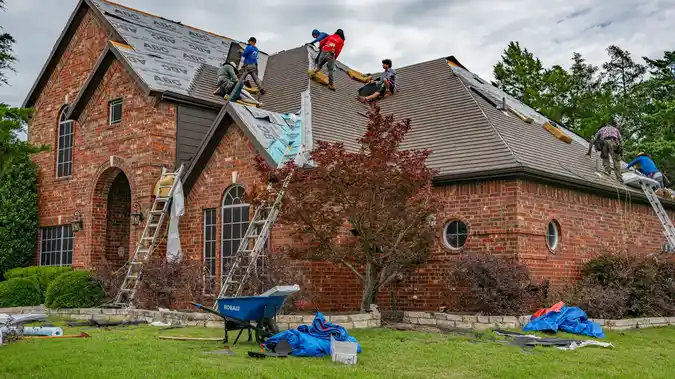
Hiring and pricing soffit and fascia work — The Complete Guide

Last updated: November 17, 2026
Quick Answer: compare at least 2 written quotes, and use the scope to decide repair vs. replacement. Choose repair if the damage is local and the wood is still sound. Choose full replacement if rot, sagging, or water entry runs along a long section. Most pricing surprises come from access, hidden rot, and whether the contractor must also touch gutters, trim, or roof edges.
Key takeaways
- Soffit and fascia prices are driven less by square footage than by damage hidden behind the trim.
- A quote that only lists “replace fascia” is too thin; it should say what happens with rot, gutters, paint, and disposal.
- Repair makes sense when the problem is small and the rest of the eave is stable.
- Replacement makes more sense when the board has soft spots, repeated leaks, or loose fasteners along a long run.
- The cheapest bid can become the most expensive if it ignores rotten sheathing or rehangs a gutter on failing wood.
What does soffit and fascia work cover?
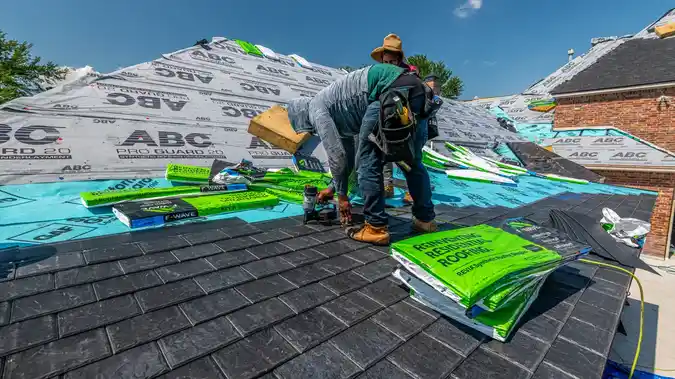
Soffit and fascia work covers the trim at the roof edge, and that usually means more than swapping a board. Fascia is the vertical board behind the gutter, while soffit is the underside of the overhang that helps close in the eave and, in many homes, supports ventilation openings. If water has been sneaking past the gutter or roof edge, the visible board is often only the last thing to fail.
That matters for hiring because the easy-looking part is rarely the full job. A contractor may need to remove gutters, pull bad trim, replace rotten backing, set new boards, prime and paint, then put the gutter back. If the soffit is vented, the work can also affect attic airflow, which is one reason a quick cosmetic patch sometimes turns into a larger repair.
For a plain guide to roof-edge moisture and ventilation, the U.S. Department of Energy’s attic guidance is a useful starting point, and the U.S. Environmental Protection Agency’s indoor moisture guidance explains why damp building materials do not stay “just cosmetic” for long. Those pages do not price the work, but they help frame why hidden moisture drives cost. If you are unsure what your roof edge needs, consult a professional roofer or carpenter and compare the findings against those guidance pages.
https://www.energy.gov/energysaver/attics
https://www.epa.gov/mold
The main hiring mistake is to treat soffit and fascia as decorative trim. They are trim, but they also sit on the edge of the roof system. If a board is soft enough to crumble when pressed, the work has likely moved past a paint job.
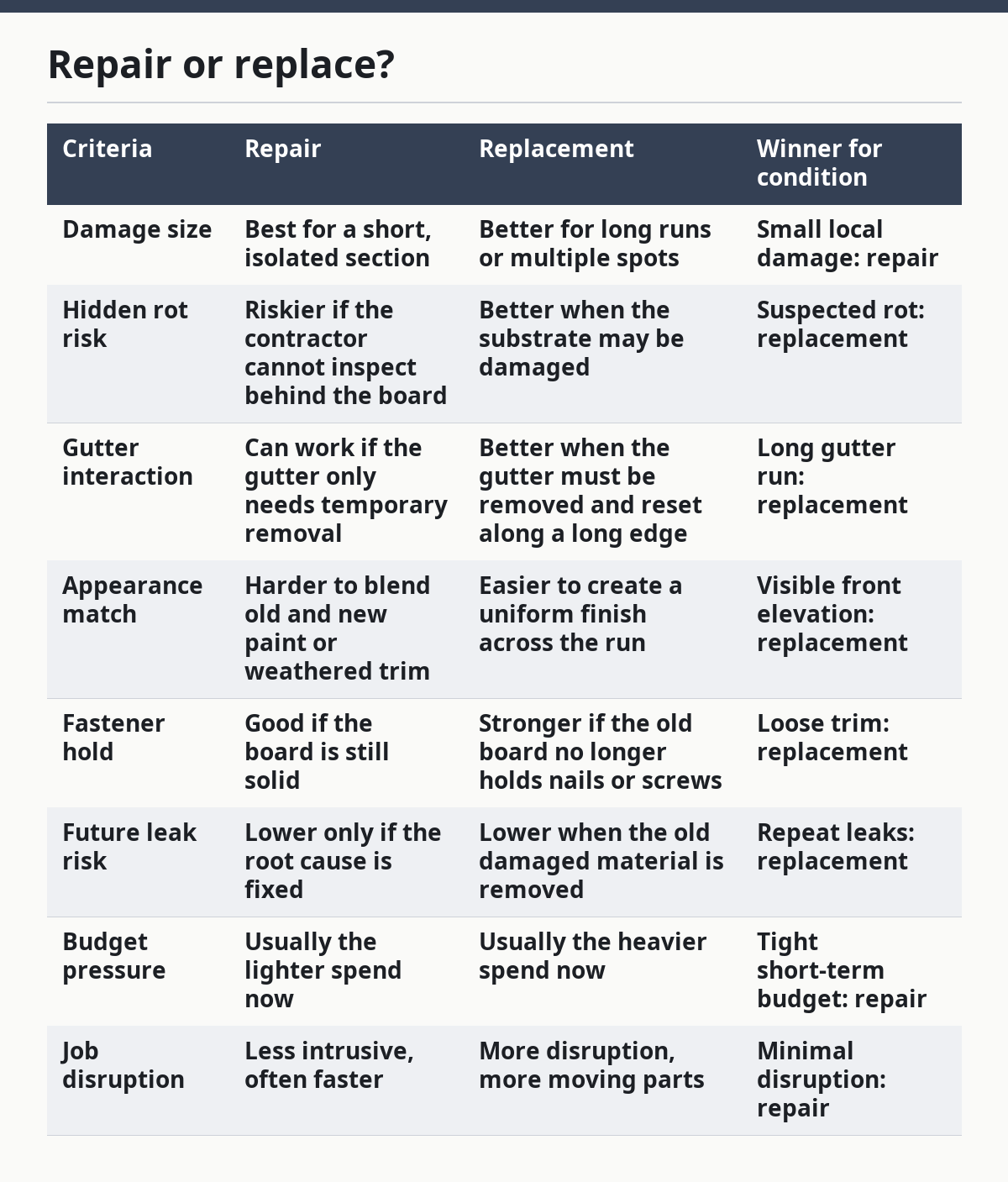
Repair or replace?
Repair wins when the damage is small and the rest of the run is still firm. Replacement wins when rot, cracking, or sagging has spread far enough that the board cannot reliably hold fasteners or support the gutter above it.
Here is the cleanest way to think about it: if the issue is a short section with a clear cause, repair can be the right spend. If the issue is repeated water damage, backed-up gutters, or widespread softness, replacement is often the safer buy because a patch leaves the weak material in place. That weak material often fails again near the next storm.
| Criteria | Repair | Replacement | Winner for condition |
|---|---|---|---|
| Damage size | Best for a short, isolated section | Better for long runs or multiple spots | Small local damage: repair |
| Hidden rot risk | Riskier if the contractor cannot inspect behind the board | Better when the substrate may be damaged | Suspected rot: replacement |
| Gutter interaction | Can work if the gutter only needs temporary removal | Better when the gutter must be removed and reset along a long edge | Long gutter run: replacement |
| Appearance match | Harder to blend old and new paint or weathered trim | Easier to create a uniform finish across the run | Visible front elevation: replacement |
| Fastener hold | Good if the board is still solid | Stronger if the old board no longer holds nails or screws | Loose trim: replacement |
| Future leak risk | Lower only if the root cause is fixed | Lower when the old damaged material is removed | Repeat leaks: replacement |
| Budget pressure | Usually the lighter spend now | Usually the heavier spend now | Tight short-term budget: repair |
| Job disruption | Less intrusive, often faster | More disruption, more moving parts | Minimal disruption: repair |
Repair is wrong for any section that feels spongy, bows away from the roof edge, or has repeated staining. A small patch on deteriorated fascia can buy time, but it does not restore structure. If the gutter is already leaning because the wood behind it has weakened, a patch may hide the problem until the next heavy rain.
Replacement is not the first call for every cracked board. A house with one wind-damaged corner does not need a full perimeter overhaul just because one contractor prefers larger jobs. The right rule is simple: if the bad area is local, repair is fair; if the deterioration tracks along a line, replacement is the cleaner fix.
How do contractors price soffit and fascia work?
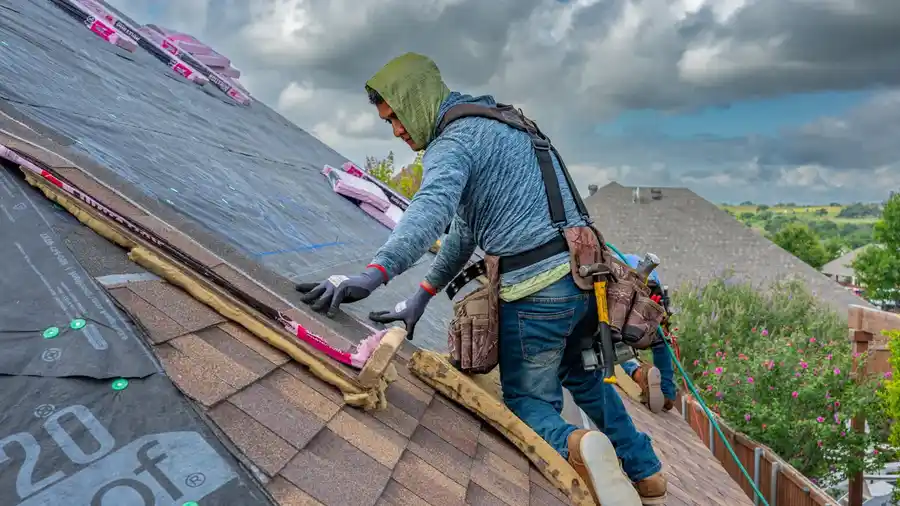
Contractors price soffit and fascia work by labor, material, access, and what they uncover after opening the edge. The board itself is rarely the whole bill. The real cost drivers are the hours spent getting to the edge, removing gutters, dealing with rot, and finishing the surface so the repair does not stand out.
The first factor is access. A one-story rear eave is easier than a two-story front corner above landscaping, a deck, or a steep slope. The second factor is material choice. Wood, vinyl, aluminum, and composite trim all bring different handling and finishing needs, and the quote should say what product is included rather than leaving that vague. The third factor is hidden damage. Once the trim comes off, rotten framing or sheathing can force a larger repair.
A useful way to separate a real quote from a guess is to ask what is included in the removal and reset. If the estimate covers only “install new fascia,” it may exclude gutter removal, fascia board replacement behind the gutter, paint, sealant, and disposal. That kind of quote looks neat on paper and grows in the field.
For the buyer, the practical lesson is that soffit and fascia pricing is often task-based, not purely linear-foot based. A short run with hard access can cost more than a longer run with easy access if the short run needs careful removal, ladder repositioning, and several layers of repair. That is why a single “per-foot” number can mislead.
Therefore, compare scope, not just line items. Two quotes can both mention fascia and still cover very different work. One may be a quick cosmetic swap, and the other may include rotten substrate, paint prep, and gutter reset.
What should a good quote include?
A good quote should list the exact scope, the materials, the access assumptions, and the finish work. If it does not, the price is not really comparable to another bid.
At minimum, the quote should say which sections are being repaired or replaced, whether the gutters are coming off, whether hidden rot is included or excluded, what material is being used, and whether paint or caulk is part of the price. A contractor should also state what happens if more damage appears after removal. That clause matters because soffit and fascia work often reveals the weak spot only after the first layer comes off.
Here is a simple quote checklist that keeps bids honest:
- Section of roof edge covered
- Repair or full replacement
- Material type and finish
- Gutter removal and rehang
- Rotten wood policy
- Paint, primer, sealant, and caulk
- Disposal of old materials
- Cleanup
- Access assumptions, such as one-story or two-story work
- Change-order trigger if hidden damage appears
A good quote does not need fancy language. It needs fewer surprises. A contractor who can name the exact conditions that would change the price is usually more useful than one who promises a tidy number and leaves the details vague.
This is also where a homeowner should ask one direct question: “If you open the edge and find rot, what happens next?” The answer should be specific. If the response is “we will figure it out later,” expect the final bill to move.
Which bid should I trust?
The best bid is usually the one that matches the scope of work, not the lowest number on the page. A lower price is only useful if it covers the same materials, the same access, and the same hidden-damage risk as the other bids.
The strongest bid usually names the board type, explains how the contractor will handle gutters, and says whether repainting is included. That matters because fascia work often looks identical from the outside while hiding very different labor. A bid that omits paint may be fine if you want only structural repair, but it is not apples-to-apples against a bid that finishes the board and blends the trim.
A bid can also be too high for the wrong reason. Some contractors price soffit and fascia work as if every job requires a full perimeter rebuild, even when the damage is local. That is overkill for a small repair and a bad fit if the roof edge is otherwise sound. On the other hand, a very low bid may skip the labor needed to expose and fix the real source of the problem.
The best way to compare bids is to put the missing pieces side by side. If one contractor includes gutter removal, underlayment patching, and repainting while another excludes all three, the second bid is not truly cheaper. It is thinner.
If the contractor will not explain what is excluded, that is not a minor communication issue. It is a pricing risk.
When does repair make more sense than replacement?
Repair makes more sense when the damage is limited, the board is still solid, and the gutter system is not pulling against rotten wood. In those cases, a focused fix saves money now and avoids opening up parts of the eave that do not need attention.
A repair is often the right call when the damage came from a single event, such as a loose section, a small leak, or a localized impact. It also fits when the home is due for a larger exterior project later and the soffit and fascia only need a temporary stopgap. In that case, a neat repair can bridge the gap until the bigger project happens.
The drawback is that repair can hide a bigger problem if the source of the leak is not fixed. A repaired board over bad flashing, clogged gutters, or ongoing moisture exposure will fail again. That creates a loop: pay once to fix the visible damage, then pay again when the underlying cause shows up in the same place.
Repair is wrong when the same spot has already been fixed more than once. Repeated repair tells the story. The wood is not the main problem anymore; the moisture path is. Once the material has lost strength or the fasteners no longer hold, replacement becomes the better value.
A practical sign: if the contractor can remove a short section, find sound wood around it, and leave the rest of the run in place, repair is still in play. If opening the board reveals softness beyond the first bad area, the job has changed.
When does replacement make more sense than repair?
Replacement makes more sense when the damage is broad, the wood is soft, or the fascia can no longer support the gutter safely. That is the point where a repair becomes a short pause before the same issue returns.
Because replacement opens the edge more fully, it is often the better choice when water has been getting behind the trim for a while. Staining, peeling paint, swelling wood, and sagging lines are all signs that the material is not just ugly; it is failing. If the soffit is damaged too, the job can spread fast because one bad edge often feeds another. In that case, replacing the whole affected run gives the contractor a sound base and gives the homeowner a more predictable result.
The downside is cost and disruption. Replacement takes longer, can require more material, and often means more steps around the gutter and paint. A homeowner who only wants a small patch may dislike the extra scope, especially if the visible damage seems minor. That said, a bigger job can still be the better buy if the smaller fix would only cover the symptom.
Replacement is not the right answer for every crack or paint failure. A board with cosmetic wear but no softness does not need to be ripped out just because it is old. The point is to replace failed material, not to chase age alone.
A sensible rule is this: if the board no longer does its job, replace it. If it still does its job and only the surface is tired, repair or refinish may be enough.
What are the exception cases?
The overall rule flips in a few cases, and those cases matter because they can change the right choice by a lot. The most common exception is hidden structural damage. If removal reveals rotten backing or a failing edge behind the fascia, a small repair stops being the smart move even if the visible area looked minor.
Another exception is a house with difficult access. A small, isolated repair on a steep or awkward roofline can cost more than expected because setup time and safety gear matter as much as board length. In that case, the “small job” is not really small for the contractor, so the price can feel out of line with the amount of visible damage.
A third exception is a gutter system that must be removed anyway. If the gutter is already loose, leaking, or badly pitched, the fascia work may be tied to a larger edge repair. Then a replacement can be the cleaner path because the contractor is already opening the whole line.
A fourth exception is matching an older exterior finish. If the home has weathered trim and a repair would stand out in plain view, replacement of a longer section may produce a better final look even when the damage itself is not huge. That is a cosmetic exception, but on a front elevation it can matter.
The point of these exceptions is not to make the decision fuzzy. It is to keep a small visible problem from hiding a larger one.
How do I avoid hiring mistakes?
The easiest way to avoid hiring mistakes is to compare scope, ask about hidden damage, and make sure the quote names what is included. The wrong contractor for this job is the one who treats soffit and fascia as simple trim with no roof-edge consequences. If you are unsure whether the answer sounds complete, consult a professional roofer or carpenter before you sign.
Start with the cause. If the contractor does not look for why the board failed, the fix may only solve the symptom. Clogged gutters, bad flashing, or recurring moisture must be part of the conversation because the new board will suffer the same fate if the cause stays in place.
Next, ask what happens if the opening reveals rot. That answer should tell you whether the contractor can handle the surprise or whether the price will jump with every uncovered board. A good estimate explains that condition before the work begins.
Then ask about finish work. A bare board replacement and a finished exterior repair are not the same product. Primer, paint, caulk, and cleanup all change how complete the job feels when the crew leaves.
Finally, make the contractor name the scope in plain language. “Replace fascia on the front elevation, remove and reinstall gutter, replace any rotten backing found in the opened section, prime and paint new boards” is much better than “fascia repair.” The first sentence is a job. The second is a hope.
What should I do before I accept a price?
You should compare at least two written quotes and make sure they cover the same scope. If one estimate is much shorter than the others, it may be leaving out the expensive part rather than pricing more efficiently.
Before you accept a price, check whether the contractor has defined the repair area, the material, the finish, and the hidden-damage rules. Ask whether the gutters will come off, whether the soffit venting will stay functional, and whether paint is included. If any of those answers are vague, the quote is still unfinished.
This is also the moment to decide whether you want repair or replacement based on the condition of the wood, not the neatness of the number. A lower price is not a win if it only postpones the same failure. On the other hand, a broad replacement is not always wise if the damage is truly isolated and the rest of the eave is sound.
For homeowners comparing bids, the useful questions are practical:
- What exact section is covered?
- Is hidden rot included or excluded?
- Will the gutter be removed and reset?
- Does the price include primer and paint?
- What changes if more damage is found?
If the contractor answers those clearly, the price becomes usable. If not, the number is just a guess with a letterhead.
The Verdict: which one should you choose?
Choose repair if the damage is local, the wood is still firm, and the root cause has been fixed. Choose replacement if rot, sagging, or repeated leaks have spread along the run or if the fascia no longer holds the gutter securely. Neither if the quote does not define hidden rot, gutter removal, and finish work, because that bid is too vague to trust.
FAQ
How much should soffit and fascia work cost?
It should be priced by scope, not by a single number alone. The final quote usually depends on access, how much hidden rot is found, whether gutters must come off, and whether the job includes paint and cleanup. A quote that only names the board replacement is not complete enough to judge fairly.
Is fascia replacement more expensive than soffit repair?
Not always, because the cost depends on what is attached to the fascia and what is behind it. Fascia work often becomes pricier when gutters need removal or the backing is rotten, while soffit repairs can climb when venting, access, or long overhead runs make the job slower. The bigger number is often the one with more hidden work.
Can a contractor repair just one section of soffit or fascia?
Yes, if the surrounding material is sound and the problem is truly local. A short repair is reasonable when the board still holds fasteners and the moisture source has been corrected. If the same area has failed more than once, a section-only fix is usually the wrong call.
What is the biggest red flag in a quote?
The biggest red flag is a quote that says “fascia repair” without naming what is included. If it does not mention gutter removal, rotten wood, paint, or disposal, the price may be too thin to compare with a better quote. The missing details are usually where the surprise cost shows up.
Should I fix soffit and fascia before painting the house?
Yes, if the trim is soft, cracked, or stained from moisture. Paint does not solve rot, and fresh paint over failing wood only hides the problem for a short time. A sound repair first gives the paint a real surface to cover, which is the only way the finish is worth the spend.
Drafted with AI; not yet reviewed by a person.