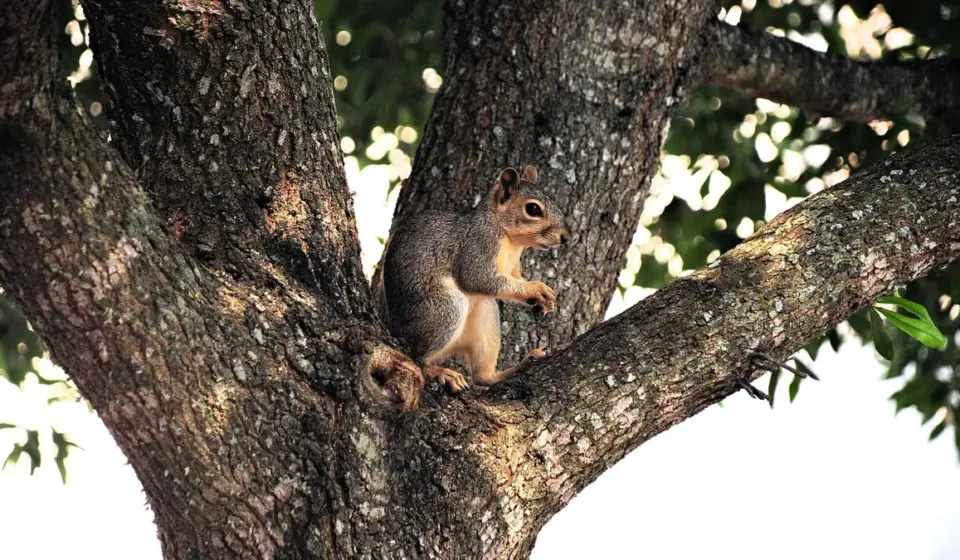

Squirrels usually get into a soffit through gaps where the soffit meets the fascia or an outside wall, through attic or gable vents that aren’t screened, through rotted or gnawed boards, or through gaps at roof and chimney flashing — often launching from a tree limb within 8 to 10 feet of the roofline. Confirm the opening is empty, then seal it with heavy wire mesh or sheet metal. Never seal a hole while an animal may still be inside.
Key takeaways
- Squirrels enter through soffit-to-fascia or soffit-to-wall gaps, unscreened vents, rotted boards, and roof or chimney flashing gaps — often by jumping from a tree limb near the roofline.
- They squeeze through gaps as small as 1.5 inches across and gnaw them wider if the wood is already soft.
- Confirm a hole is empty before sealing it. Loosely stuff crumpled newspaper in the opening and check back after a few days undisturbed.
- Never seal an occupied entry point — it traps the animal inside the wall or attic, where it will die and cause an odor and pest problem.
- Soffit inspection and sealing is single-story ladder work. Above that height, or if framing is involved, call a licensed pest control or wildlife control professional.
How do squirrels get into a soffit?
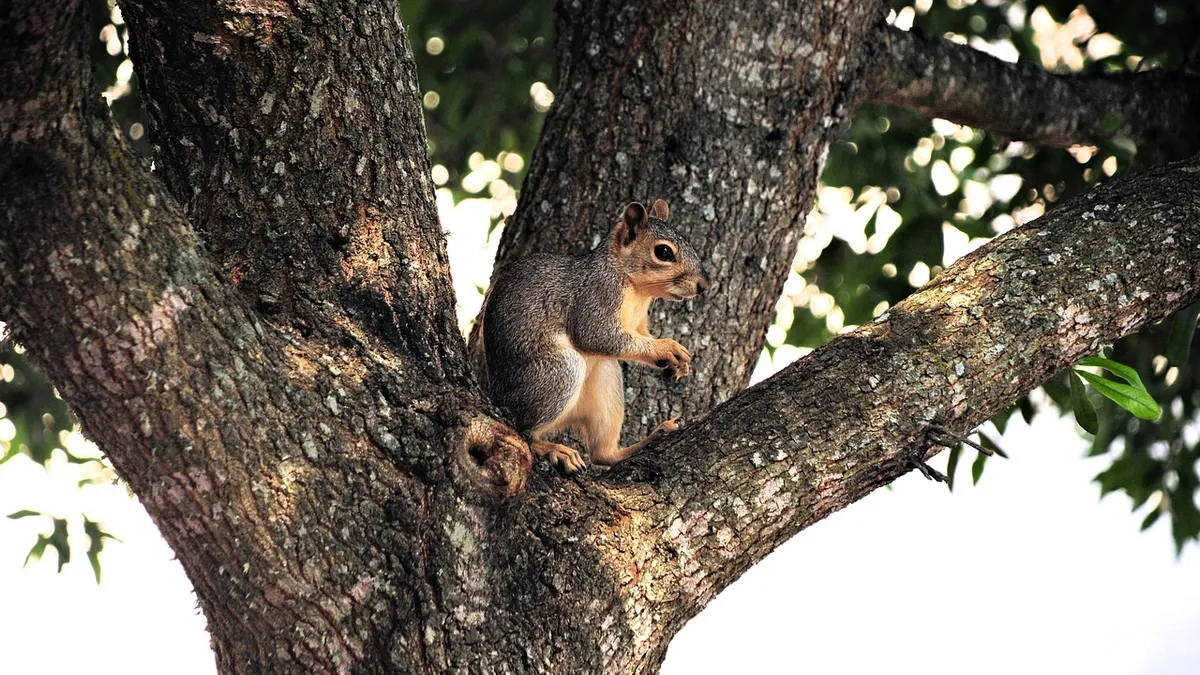
A soffit is rarely a squirrel’s first target. It’s an easy opportunity once the animal is already on the roof, and the roofline is where most of these problems start. Texas A&M AgriLife Extension’s guidance on tree squirrels notes that squirrels usually gain entrance to attics and other structures from the roof, especially where tree limbs overlap the roofline, and recommends trimming branches back 8 to 10 feet from the house so animals can’t jump directly onto it.
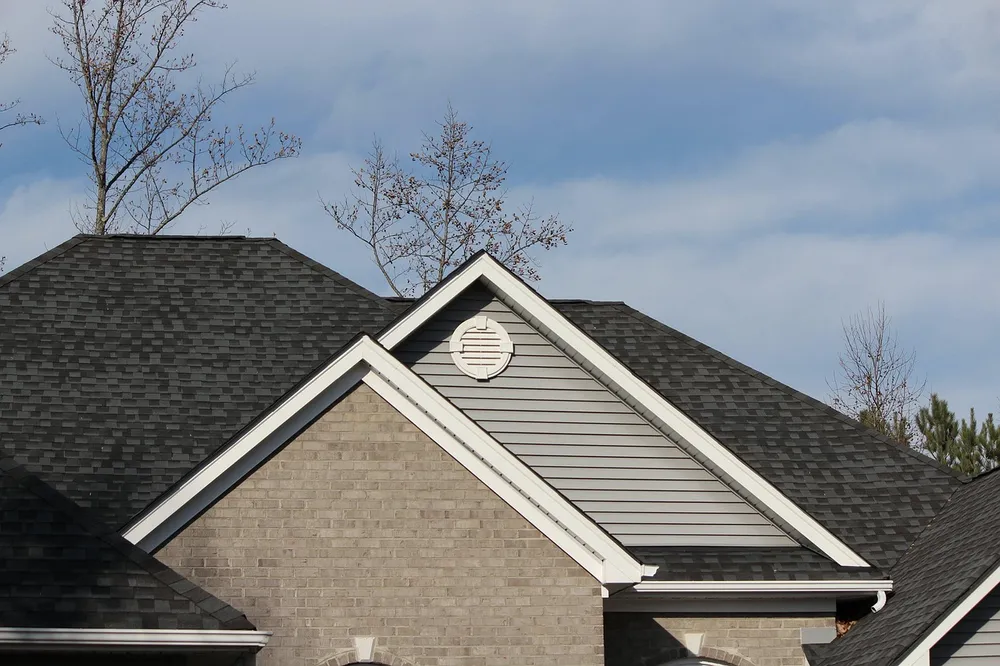
Once a squirrel is on the roof, the soffit is one of the softest targets on the whole exterior. The University of Nebraska–Lincoln Extension lists vents, chimneys, broken windows, knotholes, and gaps under eaves or gables as common entry points, and notes that squirrels can squeeze through holes as small as 1.5 inches in diameter — about the width of a thumb — and will gnaw an opening larger if it isn’t quite big enough yet. A soffit that’s already cracked, warped, or starting to rot gives them exactly that kind of soft starting point. If you’re not sure which board is the soffit and which is the fascia, our soffit vs. fascia guide walks through telling them apart in a few seconds.
Where to check: the 5-point entry inspection
Walk the roofline and look specifically for these five things. The graphic and table below cover the same five checks, so use whichever format is easier to work from outside with a phone or a printed copy in hand.
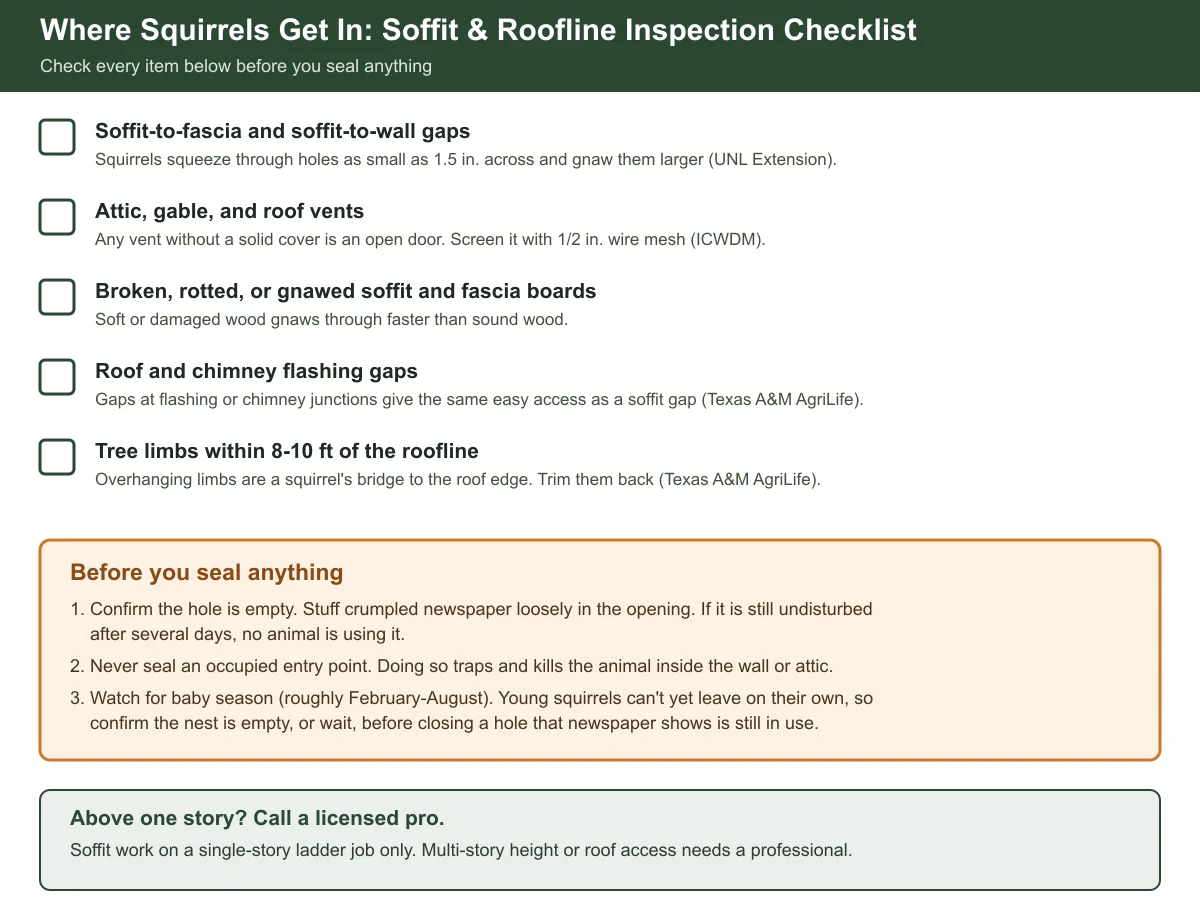
| Where to look | What makes it an entry point | Source |
|---|---|---|
| Soffit-to-fascia and soffit-to-wall gaps | Squirrels squeeze through gaps as small as 1.5 in. and gnaw them larger | UNL Extension |
| Attic, gable, and roof vents | Any vent without a solid cover is an open door; screen with 1/2 in. wire mesh | ICWDM |
| Broken, rotted, or gnawed soffit/fascia boards | Soft or damaged wood is easier to widen into a full opening | UNL Extension |
| Roof and chimney flashing gaps | Gaps at flashing or chimney junctions give the same easy access as a soffit gap | Texas A&M AgriLife |
| Tree limbs within 8-10 ft of the roofline | Overhanging limbs let squirrels jump straight onto the roof, bypassing the ground entirely | Texas A&M AgriLife |
How do you confirm a hole is empty before sealing it?
This is the step that’s easiest to skip and the most important one not to. The Internet Center for Wildlife Damage Management (ICWDM), a wildlife-damage consortium backed by university extension programs including the University of Nebraska–Lincoln, recommends placing a loose wad of newspaper in the suspected opening. If it’s still sitting there, undisturbed, after several days, nothing is using that hole. If it’s been pushed out, pulled in, or shredded, an animal is still active there and the hole isn’t ready to seal.
Timing matters too. ICWDM guidance warns that care must be taken to avoid sealing in young, since squirrels can have young in the nest roughly February through August, and some species mate twice a year. A hole that looks quiet in early morning can still have a mother out foraging and young still inside. If you’re inspecting during that window and the newspaper test comes back ambiguous, give it more time, or treat the opening as occupied until you’re sure.
How do you seal a squirrel entry point for good?
Once you’ve confirmed an opening is empty, repair and exclusion go together. ICWDM recommends closing openings with heavy 1/2-inch wire mesh, aluminum flashing, or other suitably sturdy repairs — squirrels can and will gnaw through thin plastic, foam, or anything soft enough to bite through. The Texas A&M AgriLife guidance agrees: sheet metal, hardware cloth, and steel wool all hold up against gnawing, where caulk or spray foam alone won’t.
If the board itself is cracked, soft, or rotted rather than just gapped, patching over it doesn’t solve the underlying problem — the wood will keep failing and the gap will reopen. Our guide to signs of soffit and fascia rot or damage covers how to tell cosmetic wear from wood that actually needs to be replaced before you seal anything over it.
What if a squirrel, or a nest, is already inside?
If the newspaper test shows the hole is still active, don’t seal it. ICWDM describes one-way doors as an effective tool when young aren’t a concern: the device lets an animal exit but not re-enter, and is installed with a wide apron, at least a foot square, around the hole so the squirrel can’t simply chew a new opening next to it. Once the animal has left through the one-way door and enough time has passed to be reasonably sure no young remain behind, the opening can be sealed permanently.
If you can hear scratching, chewing, or young squirrels (a higher-pitched, more constant sound than adults) inside a wall or attic space, or you’re not confident judging whether the nest is active, a wildlife control professional can confirm it safely without guesswork. This is also the point to call a pro if the entry point turns out to be more than roof access away — multi-story soffits, or anywhere framing or electrical wiring is exposed, are not a DIY repair.
Ladder safety for soffit inspections
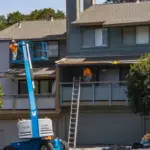
Set the ladder’s base out 1 foot for every 4 feet of height (roughly a 75° angle), and let the top extend at least 3 feet above the roofline or landing point for a handhold. Keep three points of contact at all times, stay off the top three rungs, use a spotter if you can, and set up on solid, level ground in non-slip shoes. Never use a metal ladder near power lines. If the soffit is above a single story, or the job means working from the roof itself, call a licensed contractor instead.
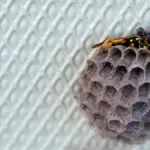
Squirrels aren’t the only soffit visitor that needs a safety-first approach — see our guide to wasps or bees nesting in the soffit if you spot an insect nest instead of (or along with) squirrel damage.
Frequently asked questions
How do I know if it’s squirrels and not another animal?
Squirrels are typically active during the day, so scratching, running, or light scurrying sounds in daylight hours point to squirrels rather than nocturnal animals like raccoons or rats. Gnawed, enlarged holes around 1.5 to 2 inches across with rough wood edges are also a squirrel signature, versus the much larger openings raccoons leave.
Can I use caulk or spray foam to close a squirrel hole?
No. Both University of Nebraska–Lincoln and Texas A&M AgriLife Extension point to heavy wire mesh, sheet metal, or hardware cloth specifically because squirrels can gnaw through caulk and foam in minutes. Soft sealants only work as a very temporary measure and shouldn’t be considered a finished repair.
Is it legal to just seal a squirrel out without removing it first?
Sealing an entry point after confirming the animal is out, using the newspaper test or a one-way door, is standard practice. Sealing an occupied hole without confirming it’s empty isn’t a legal question so much as an animal-welfare and practical one: it traps and kills the animal inside your wall, which usually means an odor problem and possibly more digging to get the carcass out.
Do squirrels come back to the same spot after you seal it?
They can try, especially if the surrounding wood is still soft enough to re-gnaw or if a nearby entry point (a second vent, a different soffit gap) is still open. That’s why the 5-point inspection above covers the whole roofline rather than just the one hole you noticed — sealing one opening while three others remain open just redirects the animal a few feet over.
Does trimming trees actually make a difference?
Yes, according to Texas A&M AgriLife Extension, which recommends trimming branches back 8 to 10 feet from the roofline specifically because squirrels use overhanging limbs to jump onto roofs. It won’t stop a determined squirrel that can also climb a wall or downspout, but it removes the easiest, most direct route.
Sources
- University of Nebraska–Lincoln Extension (Backyard Farmer), Squirrels — common entry points (vents, chimneys, gaps under eaves and gables), minimum gap size squirrels can use, and sealing with metal mesh or hardware cloth. Checked November 13, 2026.
- Texas A&M AgriLife Extension Wildlife Services, Tree Squirrels (Pub. L-1914) — roof and tree-limb access routes, the 8-10 ft trimming recommendation, exclusion materials, and the rule against sealing before squirrels are out. Checked November 13, 2026.
- Internet Center for Wildlife Damage Management, Tree Squirrel Damage Prevention and Control Methods — the newspaper-test method for confirming a hole is empty, 1/2-inch wire mesh sealing guidance, one-way doors, and the February-August young-rearing window. Checked November 13, 2026.
soffitfasciafix.com Editorial Team. Last updated: November 13, 2026.

[…] Squirrels in the Soffit: Finding and Sealing Entry Points […]