Wood Soffit vs Vinyl Soffit: Which Should You Choose?

Last updated: November 17, 2026
Quick answer: for most homes, vinyl soffit is the lower-maintenance choice, while wood soffit is the better fit when you need a traditional look, paintability, or a close match to existing trim. In plain terms, the decision usually comes down to 2 things: upkeep and appearance.
Key takeaways:
- Vinyl usually wins on upkeep because it does not need the same paint cycle as wood.
- Wood wins on appearance when the goal is a natural material that matches older trim and fascia.
- Vented soffit matters as much as the material if attic airflow is part of the problem.
- Wood is the weaker choice in damp locations because rot and peeling paint can return.
- Vinyl is not the right answer for every home, especially where historic details matter.
What is the real difference?
Wood soffit and vinyl soffit do the same job, but they ask for very different upkeep. Wood is a traditional building material that usually gets primer and paint, while vinyl is a low-maintenance cladding that is commonly used in vented and solid panels.
The difference that matters most is not just appearance. It is how often the soffit will need attention over the next several years. Wood can be repaired and painted to blend with older houses, but it also needs more care around moisture, exposed edges, and nail holes. Vinyl is less fussy about paint maintenance, but it can look out of place on some homes and may not match older trim as cleanly.
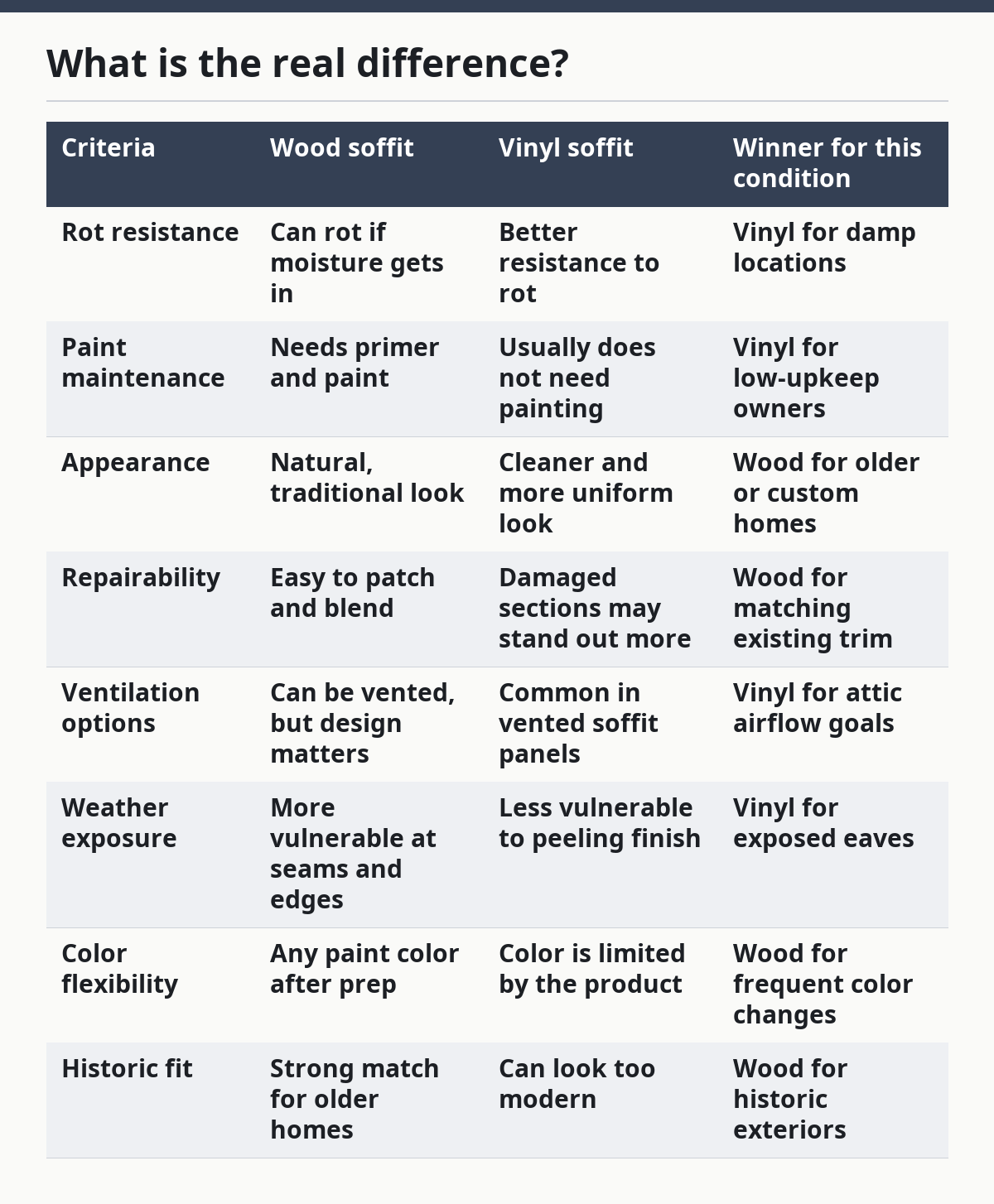
| Criteria | Wood soffit | Vinyl soffit | Winner for this condition |
|---|---|---|---|
| Rot resistance | Can rot if moisture gets in | Better resistance to rot | Vinyl for damp locations |
| Paint maintenance | Needs primer and paint | Usually does not need painting | Vinyl for low-upkeep owners |
| Appearance | Natural, traditional look | Cleaner and more uniform look | Wood for older or custom homes |
| Repairability | Easy to patch and blend | Damaged sections may stand out more | Wood for matching existing trim |
| Ventilation options | Can be vented, but design matters | Common in vented soffit panels | Vinyl for attic airflow goals |
| Weather exposure | More vulnerable at seams and edges | Less vulnerable to peeling finish | Vinyl for exposed eaves |
| Color flexibility | Any paint color after prep | Color is limited by the product | Wood for frequent color changes |
| Historic fit | Strong match for older homes | Can look too modern | Wood for historic exteriors |
Therefore, the best source for this choice is not a sales page. It is the actual condition of the eaves, the look of the house, and the amount of maintenance the owner will accept. For background on exterior material behavior, the USDA Forest Products Laboratory is a useful reference, and the Vinyl Siding Institute is a practical starting point for vinyl exterior products.
Wood soffit: who should actually use it?
Wood soffit is the better choice for homes that need a traditional finish, custom paint color, or close visual match to existing trim. It is the material to pick when appearance matters more than low maintenance.
Wood wins because it is easy to paint and easier to blend into older construction. A primer and paint system can match fascia, trim, and siding in a way vinyl sometimes cannot. For a house with visible roof overhangs, crown details, or older porch eaves, wood often looks more natural than plastic panels.
The drawback is real: wood asks for upkeep. If the primer breaks down, water gets in, or paint starts peeling, the soffit can rot. That means the owner is trading a better finish for more attention. The USDA Forest Products Laboratory’s Wood Handbook is a useful reference on how wood behaves when exposed to moisture and decay pressure, and it is the kind of warning that matters here: wood performs well when protected, then loses ground fast when protection fails.
Source: USDA Forest Products Laboratory, Wood Handbook — https://www.fpl.fs.usda.gov/documnts/pdf2010/fplgtr190.pdf
In particular, wood is also the weaker pick for anyone who wants a set-it-and-forget-it exterior. If the home is on a shaded lot, in a wet climate, or near recurring roof leaks, wood soffit is the material most likely to keep asking for paint, spot repair, or replacement of damaged pieces. It is not the easiest option, and that is the point.
Vinyl soffit: when does it win?
Vinyl soffit wins when the priority is lower maintenance and stronger resistance to rot in everyday use. It is the better fit for homeowners who want vented soffit without the burden of regular painting.
Vinyl does not need the same primer-and-paint cycle as wood, which is the biggest reason it gets chosen. That matters for owners who do not want to repaint soffits every time the rest of the trim gets refreshed. It also fits well in a typical maintenance plan where the goal is to reduce upkeep on hard-to-reach eaves.
Since ventilation matters on many rooflines, vinyl is often the practical choice when airflow is part of the design. Vented soffit panels are common in vinyl systems, and the material is widely used on eaves that need consistent airflow into the attic. That does not make vinyl a magic fix for roof problems, but it does make it a sensible material when soffit ventilation is part of the plan.
The trade-off is appearance and flexibility. Vinyl can look too uniform on a house that already has detailed trim or older woodwork. It also gives up the easy color changes that come with wood and paint. If the home needs a very specific historic look, vinyl may be the wrong visual fit. The Vinyl Siding Institute is a useful starting point for understanding vinyl’s role as an exterior cladding product and the basic care expectations that come with it.
Source: Vinyl Siding Institute — https://www.vinylsiding.org/
On the other hand, vinyl is not the right pick for every home. If the soffit area needs frequent custom work, if the existing exterior is heavily detailed, or if the owner wants a finish that can be repainted in almost any color, vinyl can feel limiting.
Which one handles rot and paint better?

Vinyl handles rot and paint better than wood, and that is the main reason it is easier to live with. Wood can be made to look better on day one, but it is more dependent on a sound paint system and dry conditions.
Rot resistance is where the choice gets blunt. Wood is vulnerable if moisture gets trapped, if the edges are left exposed, or if peeling paint lets water reach the substrate. Vinyl does not rot in the same way, so it has a clear practical advantage in a soffit location that sees rain, humidity, or splashback.
Paint maintenance is where wood creates work. It needs primer and paint to stay protected and to keep its finish looking fresh. Once that coating starts to fail, the owner is back into scraping, priming, and repainting. Vinyl avoids most of that cycle, which is why it suits people who want a cleaner upkeep schedule.
That does not mean vinyl is flawless. It can still crack, fade, or look tired over time, and damaged sections can be more obvious than a painted wood repair. However, if the question is which material asks less of the owner, vinyl wins by a wide margin.
How do they compare on ventilation and repair?
Vinyl is usually the easier choice for vented soffit, while wood is usually the easier choice for repairs that need to blend in. The winner depends on whether airflow or appearance matters more.
Vented soffit is a real design choice, not a side note. If the attic or roof edge needs better airflow, vented panels become important, and vinyl is commonly used for that purpose. It is a straightforward way to build in ventilation without creating a paint-maintenance problem at the same time.
Because wood soffit can also be vented, the design details matter more than the material alone. The openings, paint coverage, and edge sealing all affect performance. If those details are sloppy, the same material that looks elegant can become a weak point for moisture.
Repairability is where wood often feels easier. A damaged wood soffit can be patched, shaped, and painted to match the surrounding area. That matters on older homes where a small repair should disappear into the rest of the trim. Vinyl repairs can be done, but the new section may not blend as well, especially if the color has changed with age or sunlight.
For a homeowner who values small, invisible fixes, wood is stronger. For a homeowner who values airflow and low upkeep, vinyl is stronger. The decision is not about which one is universally better; it is about which problem matters more.
When does the choice flip?
The usual verdict flips in a few specific cases, and those cases are common enough to matter. The material that sounds best on paper is not always the right one for the house in front of you.
Choose wood soffit if the house is historic, if the trim needs a traditional painted finish, or if matching existing woodwork matters more than maintenance. That choice also makes sense when the soffit is part of a larger painted exterior and the owner is already planning periodic touch-ups.
Choose vinyl soffit if the home sits in a damp or exposed spot, if the soffit needs vented panels, or if the owner wants to avoid repeated primer and paint work. It also fits well when the existing exterior is simple and the goal is steady performance rather than a bespoke look.
Neither material is the right choice if the soffit problem is really a roof leak, a fascia failure, or hidden structural damage. In that case, new soffit material is not the fix; the moisture source has to be addressed first. A material swap cannot solve a water problem that is still active.
The verdict: which one should you choose?
Choose wood soffit if you need a traditional look, plan to paint it, and want a close match for older trim or historic details. Choose vinyl soffit if you want less maintenance, better rot resistance, and a practical option for vented soffit. Neither is the right answer if the eaves are already wet, damaged, or leaking, because the real problem is deeper than the covering.
For a general homeowner comparing the two, vinyl is the smarter default. Wood is the specialist choice for appearance and matching, not the easiest choice for upkeep.
If this decision sits inside a bigger exterior project, the broader material and design questions belong in the soffit fascia materials design choices hub.
Drafted with AI; not yet reviewed by a person.



[…] Wood Soffit vs Vinyl Soffit: Which Should You Choose? […]